“Everyone has a plan,” said Mike Tyson, “until they get punched in the face.”
How do we resist the brutal blows of destiny? Until it happens, it’s difficult to predict. Strength of character cannot be judged by one’s intentions, and perhaps not even by one’s convictions, even the most deeply held ones. It’s judged in the critical moments – when fate strikes and weakens even the best-prepared defenses.
This is something that’s impossible to foresee before that fateful moment. The human spirit has its flaws and weaknesses. Each of us harbors untapped strengths and, simultaneously, strange, hidden vulnerabilities – our own “kryptonites,” waiting to be revealed.
How can we respond to threats?
As the world turns upside down, with geopolitical conflicts intensifying, societies fracturing, and technological disruptions multiplying, this question becomes strategically essential for understanding our times.
Psychology offers three responses: freeze, flight, or fight.
- Freeze (paralysis) likely comes from an atavistic reflex to “play dead” when faced with a predator, which, generally, is more interested in living prey. Sometimes effective in ancient times, and although it’s widely used today in bureaucratic organizations, this tactic rarely works in truly critical moments.
- Often mocked, flight has nonetheless proven its value. While it may sometimes allow us to evade danger, it doesn’t definitively overcome it.
- Fight (combat) meanwhile, has unpredictable effectiveness. It might succeed, but it can also backfire. War is a dangerous affair.
So, which strategy prevails?
It all depends on the circumstances. But one thing is sure: whether we flee or fight, anything is better than paralysis, especially if we must endure over time.
Any energy left unexpressed turns against us. This explains the countless burnouts in today’s hyper-connected society, where stress is a constant. It also accounts for the various social derivatives of flight or fight emerging in our divided Western societies:
- Looking for scapegoats.
- Seeking escapism in drugs or dreams of afterworldly salvation.
- Withdrawing from society, like collapsologists and survivalists.
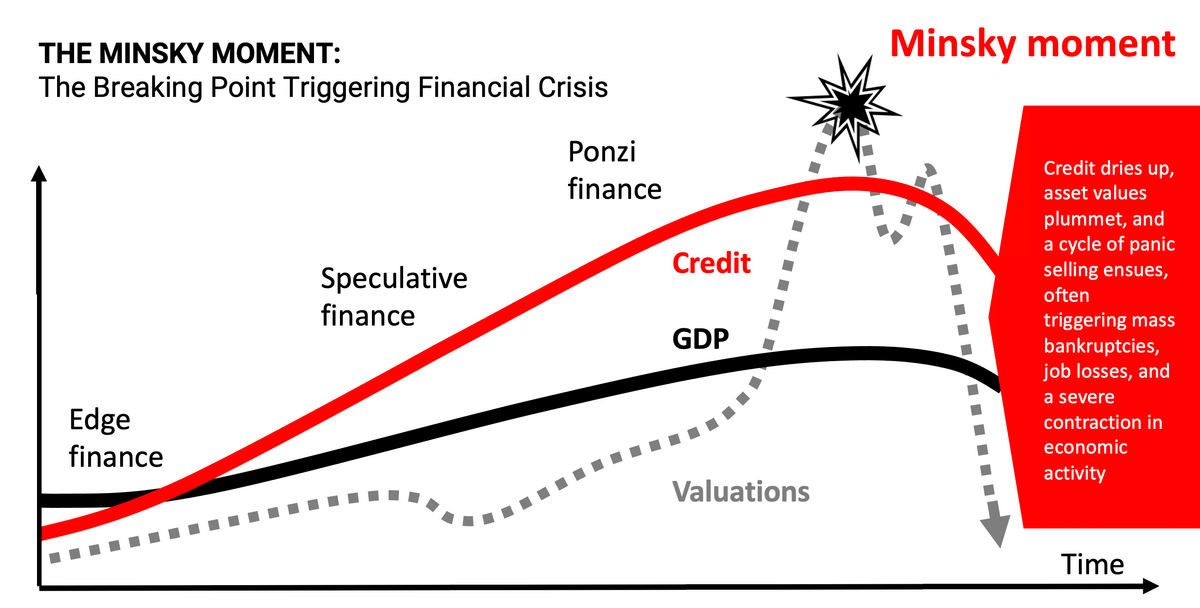
When a critical shift happens, though, the pressure intensifies. We arrive at the moment of truth – what, in finance, is known as the “Minsky moment”: the breaking point. It’s when we begin our descent toward catastrophe, marked by the five stages of collapse: financial, commercial, social, political, and cultural.
How to confront crises and collapse?
This is where crisis management emphasizes the importance of preparation: risk analysis, protection of critical vulnerabilities, and proactive prevention. As the military says, “Plans are useless, but planning is everything.”
This is also when experience highlights the need to apply a few simple principles:
- Stay groundedand begin by protecting ourselves, so we can effectively protect others.
- Remain connected to our vision, never losing hope that we will ultimately prevail.
- Confront the brutal realityof facts while proactively doing all we can to mitigate risks, focusing on our circle of control.
- Shift our thinking from risk to opportunity, exploring new target markets, offerings, or business models that the crisis might open up.
- Move quickly: a good plan executed today is better than a perfect plan imagined for tomorrow.
But above all, this is when we must summon every ounce of strength we possess. Often, when faced with disaster, we think we won’t make it. The monster looms, but we hesitate to cross the abyss. We think the gap is too wide to overcome. We forget that we have untapped resources within us – a second wind that emerges when we believe all is lost.
Will it be enough?
While it’s impossible to know how we’ll react in that critical moment, one thing is certain: when destiny strikes, when the defenses collapse, it’s then that the reflexes built over years of anticipation – and the options prepared for even the most unlikely scenarios – can make all the difference.
In the coming years, we may well need these reflexes.
This post is based on an article published on the FutureMastery website.