“This too shall pass.”
Each of us, at one point or another, has likely encountered this timeless saying of personal growth – and had to make it our own, even amid the pain of loss, failure, or illness. Even the darkest hardships eventually come to an end. As the old adage goes: time heals all.
Yet, it’s essential to move forward, to avoid clinging to a past that won’t return, and to venture toward new horizons.
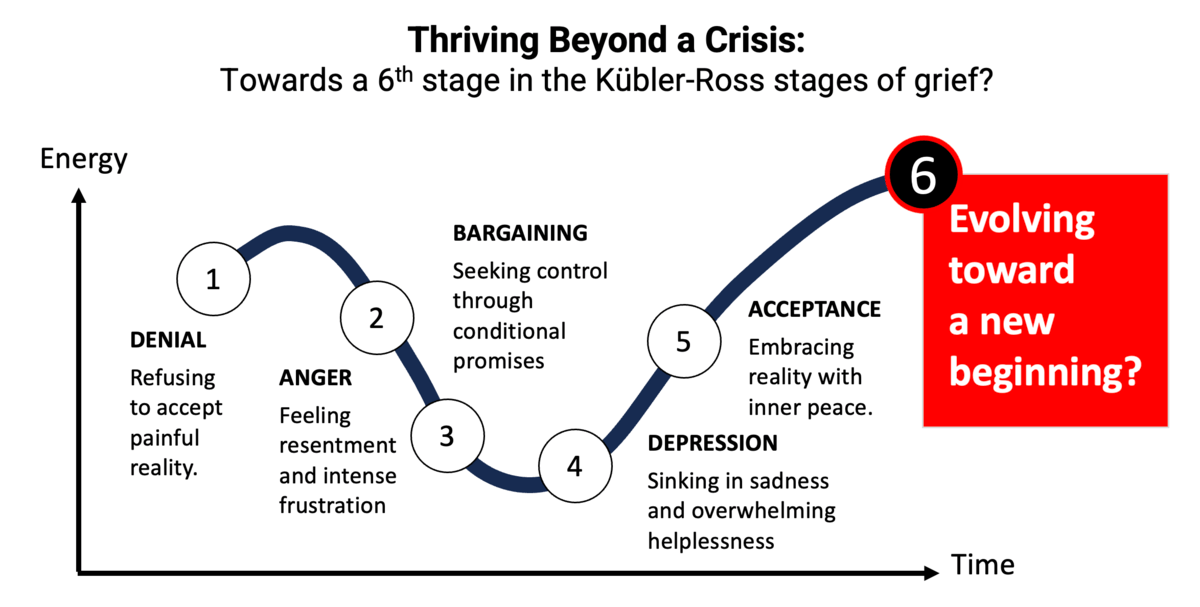
In her well-known work on approaching death, Elisabeth Kübler-Ross identifies what she calls the five stages of grief: denial, anger, bargaining, depression, and finally, acceptance.
Although originally focused on terminally ill patients, this framework also applies to many life transitions. And, perhaps we should add an additional stage: evolving toward a new beginning – a “6th stage” especially relevant after a crisis or collapse.
Because every crisis represents loss, but it also opens the door to new horizons and new possibilities.
For the past fifteen years, we have been living in a state of permacrisis. Around us, the world is changing dramatically.
Could this upheaval finally give us a radical opportunity to revolutionize the status quo?
Are new territories emerging from the depths of disaster? New value propositions? New business models?
Amid these shifts, indeed, it’s crucial to ask a strategic question each time: “What does the crisis make possible? What was once unimaginable that, due to these events, is now within reach?“
As historical studies show, it is during crises that the winners distinguish themselves from the victims, that the gap between the two widens, and that leaders lay the foundation for their future success.
How many individuals and companies have transformed catastrophes into opportunities?
The data is clear: it is during crises that the successes of tomorrow are built. Those who continue innovating at the heart of the crisis are the ones who bounce back most effectively in the following years, while others struggle to return to their former trajectory. After three years, the profitability gap between goes up to 30%!
The same applies to startups. Who remembers that it was precisely during the 2008 crisis that Airbnb and Uber launched their revolutionary sharing economy models?
Their secrets?
- The ability to transcend difficultiesand leverage them to overturn established positions
- Creativity: the drive to seek out revolutionary solutions, those that go far beyond incremental improvements. As the Silicon Valley adage goes: “don’t just aim for a 10% marginal benefit; aim to multiply it by 10!”.
- Perseverance: the constant willingness to seek, test, fail, and try again until success.
To achieve this, one must dare to break new ground, venture into uncharted territories, and try unexplored approaches.
It’s a difficult, perilous path.
But isn’t opening new horizons and creating meaning ultimately the essence of progress?
As Churchill said nearly a century ago, “Never let a good crisis go to waste.”
In these turbulent times of “global transition crisis,” we won’t lack for opportunities:
- Seize the demographic and economic boom of emerging markets.By 2060, 60% of global growth will take place in the Indo-Pacific.
- Invent tomorrow’s energies, from renewables and innovative energy storage processes to nuclear and perhaps even fusion energy.
- Integrate artificial intelligence into value chains and business processes. The concept of the autonomous enterprise opens revolutionary prospects.
- Design new governance tools for a multipolar world.The crypto and Central Bank Digital Currency (CBDC) revolution, in particular, will be massive…
More than ever, these opportunities are ours to seize.
As the saying goes: necessity is the mother of invention.
In the heart of today’s permacrisis, creativity must be our compass!
This post is based on an article published on the FutureMastery website.